What is reformer Pilates? The machine, the class and what an hour costs in Perth

Two studios on the same street can be entirely different rooms depending on who is teaching the 9.15.
First, the part this article won’t do: tell you what reformer Pilates will do for your back, your posture or your core. Nobody can honestly promise that, and a studio that leads with it is selling a pack of ten. What a directory can tell you is what the machine is, what happens in the hour, and what it costs across Perth. It can also tell you which of the several things called Pilates you would actually be booking — and that last one causes far more confusion than the machine ever does.
The common mistake is assuming reformer is the advanced version of mat, and that a few mat classes ought to come first to earn it. That gets the machine backwards. A reformer is a sliding carriage on springs, and those springs make an exercise easier as readily as harder — they hold weight you would otherwise be holding yourself. A movement can be gentler on the bed than on the floor, which is exactly why studios put complete beginners straight onto a reformer instead of making them earn it on a mat first.
| What it is | Pilates on a sprung, sliding carriage — resistance and assistance from the same springs |
| Typical class | 45–50 minutes, small group, instructor-led |
| The equipment | Carriage, springs, footbar and straps |
| Difficulty | Set by the class, not the machine — beginner to advanced |
| What to bring | Grip socks at most studios — sold at the desk if you forget |
| In Perth | 16 studios listed on Oria Haven, from the CBD to the hills |
The machine is a bed that slides, and the springs cut both ways
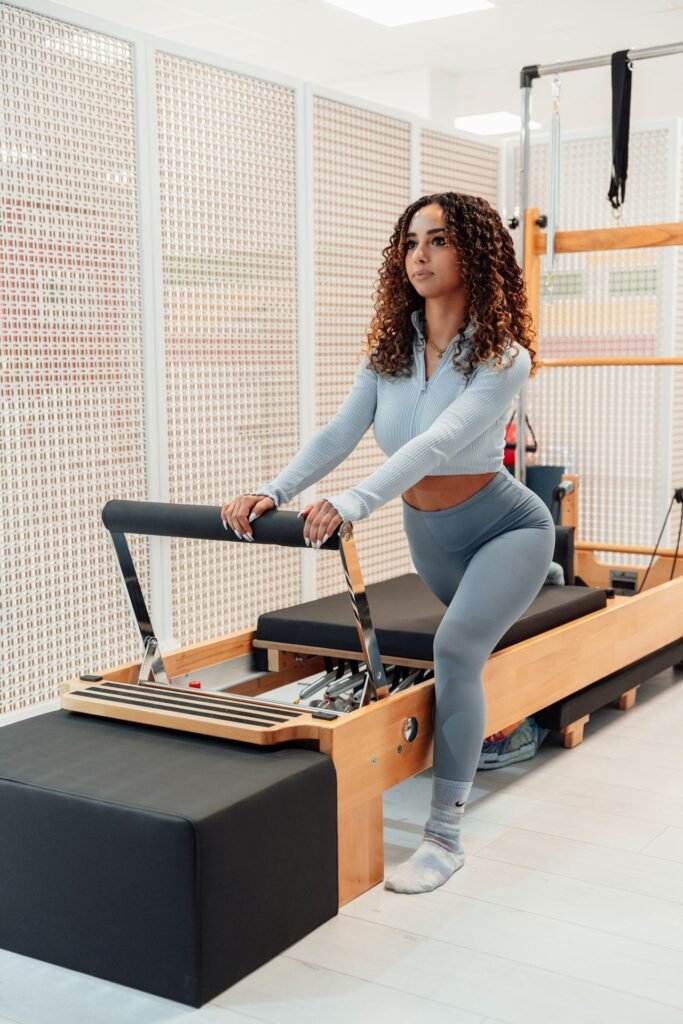
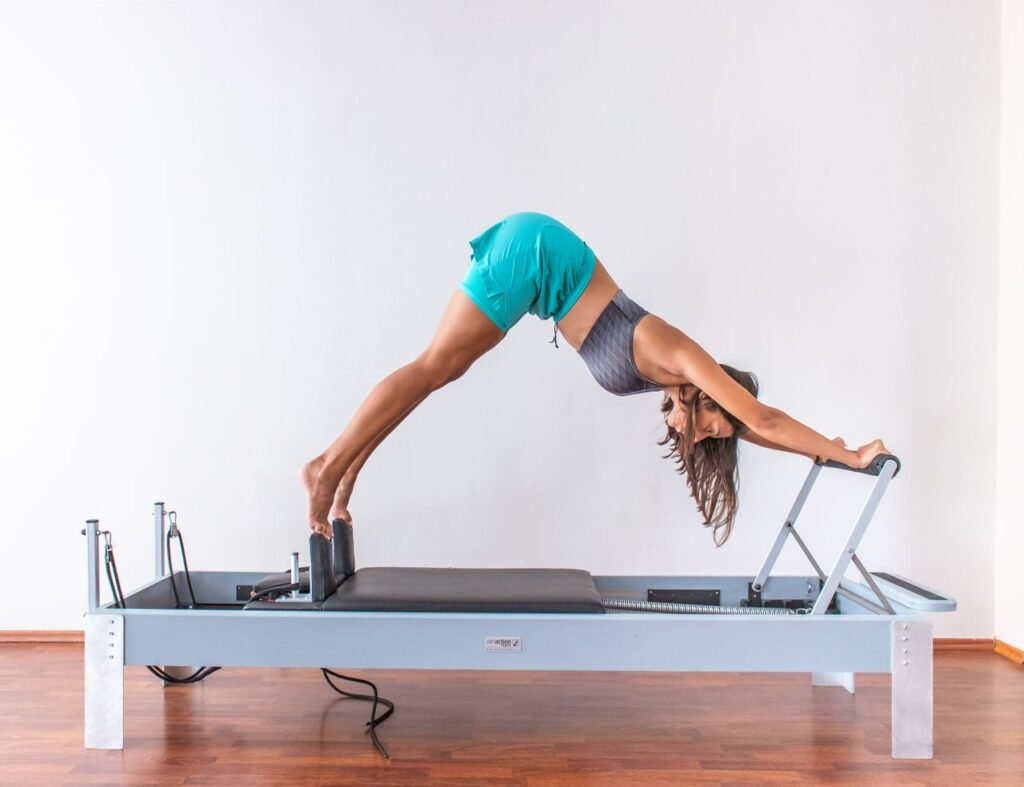
A reformer is a padded carriage running along rails inside a wooden or metal frame. At one end there’s a footbar to push against. At the other, long straps with handles that can be pulled by hand or looped around the feet. Underneath sit three to five springs of different tensions, and the instructor swaps them between exercises — usually by calling out a colour while everyone lies there quietly working out whether red is the hard one. It is a machine with roughly six moving parts and a genuinely odd history. Joseph Pilates built the first version out of hospital beds during the First World War, and the thing has never entirely lost the look.
The springs are the whole point. Add tension and the carriage resists — take it away and it runs free, which sounds like the easier option and frequently isn’t, because at that point nothing is helping to control it. An instructor who says “let’s take a spring off” has not decided to go gently. Quite the opposite.
The first class is the thing Perth studios disagree about
Most reformer studios won’t let anyone walk into a general class off the street, and this is the single most useful thing to know before browsing timetables. They ask for an intro class, a foundation course of two or three sessions, or a private with an instructor first. Some fold it into the intro offer, others charge you for it separately at a rate closer to a private session than to a class, and a few do both depending on which day of the week you happen to turn up.
It’s a reasonable rule. There are only so many beds in a room, the instructor can’t stop the other eleven people to explain your straps, and one person working against the wrong spring tension slows the entire class down. It does mean your first booking is rarely the $25 class advertised on the window, and studios are not always loud about that. Look for the words intro, foundations or beginners on the timetable before you assume Tuesday is available.
Nobody mentions the socks until you are standing at the desk
Grip socks — the ones with rubber across the sole — are required at nearly every reformer studio in Perth, and this is not a matter of house style or a way of selling you something at the counter. The carriage moves and the footbar is smooth, so bare feet slide and ordinary socks slide considerably further. Studios keep a basket of them beside the register for exactly the reason anyone would guess, which is that a good half of the people who walk through the door learn about the rule roughly ninety seconds before their first class is due to start.
Buy the socks. Bring water and something you can move in. Nothing else is needed. Nothing else is provided.
An hour costs more than a mat class, and the beds explain most of it
Reformer sits a band above mat Pilates across the studios we list in Perth, and the arithmetic is not mysterious. A reformer costs several thousand dollars, a studio fits somewhere between six and twelve of them into a room, and that ceiling stays fixed however many people want the 6am on a Monday. A mat class can take thirty. Class length is commonly forty-five to fifty minutes rather than a full hour, which catches out anyone who booked expecting sixty.
What Perth studios publish
Of the sixteen reformer studios listed on Oria Haven, six publish a casual starting price. Those run from $45 to $89 for a group class, with one clinical studio listing from $190 for assessed one-to-one work. The middle of the group sits around $70–$75.
Prices checked August 2026, from what studios publish themselves. Intro offers, packs and memberships change often — confirm with the studio before booking.
Casual rates are the expensive way in, and nearly every studio knows it. So the intro offer — a fortnight or three weeks of unlimited classes — is where you should probably start. Weigh it against a concession pack rather than a single class. The single-class price is the one almost nobody pays twice.
Clinical Pilates is the same machine behind a different front door
Clinical Pilates uses the reformer as well, and from the doorway the room looks identical — what differs is the order of events. A physiotherapist assesses you one-to-one first, writes the session from that assessment, then runs it in a group of three or four, or keeps it one-to-one. It costs more than a studio class, and where a physiotherapist delivers it private health sometimes rebates part of it. Whether yours does depends on your fund, your level of extras cover and the practitioner’s registration — ask all three before you assume any of them.
Neither is an upgrade of the other. They answer different questions altogether: one is a class you book off a timetable and turn up to, the other an appointment that happens to involve a machine.
Three things reformer is not, and one it keeps getting confused with
It isn’t yoga, though the timetables sit side by side and several Perth studios run both — the difference between them is less about difficulty than about what the hour is organised around. It isn’t barre, which uses a rail, light weights and no machine at all. And it isn’t a group fitness class with equipment, though the cap on numbers makes it feel like one.
The confusion worth clearing up is reformer against mat. When someone says they “do Pilates” without qualifying it they generally mean mat — floor work, bodyweight, sometimes a ring or a band, no intro class required and nothing at all to learn before arriving. Reformer is the one with the machine and the booking conditions. That is the whole distinction.
What a directory can’t tell you, and it happens to be the part that decides it
Here is the uncomfortable bit. We list Pilates practices right across Perth with their addresses, their timetables and their prices. We can tell you almost nothing about the one variable that decides whether you go back: the instructor. Two studios on the same street, with the same beds, the same spring colours and the same rates, turn out to be entirely different rooms depending on who happens to be teaching the 9.15 on a Wednesday — and no amount of listing data will ever catch that. The intro offer exists partly so you can find out for yourself, which is the argument for treating it as a trial rather than a discount.
Six questions worth asking before you book
- Is this class suitable for complete beginners, or is there a foundation class I should do first?
- How many beds are in the room? Six means more eyes on your form than twelve.
- What happens if I can’t keep up? The answer tells you how the studio treats new people.
- Do I need grip socks, and do you sell them or should I bring my own?
- Can I try one class before buying a pack? A studio confident in its teaching says yes easily.
- Are beginner and experienced students in the same room? Neither answer is wrong — but you want to know.
And if you are managing an injury, pain or a medical condition: ask the studio whether the class is appropriate, and speak with your relevant health professional. A good studio will take that question seriously rather than waving it through.
Where to find reformer Pilates in Perth
Once you know what sort of class you are looking for, the remaining question is where to try it. These are the reformer studios on the directory, best-rated first — the ratings are each studio’s own Google rating, reproduced.
 Niche Physio & PilatesView practice →
 The Pilates KlinikView practice →
 WA SportsMed PhysiotherapyView practice →
 RecwellView practice →
Or start from where you live — each link below goes to the fitness practices in that suburb:
What we check
Oria Haven checks that listed practices exist, are trading, and that their published details are accurate as far as we can verify them. We do not verify instructor qualifications, and pricing, timetables and class formats change — confirm details directly with the studio before booking.
Reformer Pilates FAQs
How long is a reformer Pilates class?
Most Perth studios run 45–50 minutes rather than a full hour — worth knowing before you pay an hour’s parking.
Is reformer Pilates good for beginners?
Yes, in the right class. Many studios run foundation or beginner sessions; some ask you to complete an intro class before joining the general timetable. Ask which kind you are booking.
What should I wear to reformer Pilates?
Fitted, comfortable exercise clothing the instructor can see your alignment through. Most Perth studios require grip socks and sell them at the desk.
Is reformer harder than mat Pilates?
Not automatically — they load the body differently. The springs can assist as well as resist, so a well-taught beginner reformer class can be gentler than a mat class, and an advanced one far harder.
How much does reformer Pilates cost in Perth?
Casual group classes listed on Oria Haven start between $45 and $89, with clinical one-to-one work higher. Intro offers and packs bring the per-class figure down — see the pricing section above.
What is the difference between reformer and clinical Pilates?
The machine is the same; the front door is different. Clinical Pilates runs through an assessment with a health practitioner and is programmed one-to-one or in very small groups — covered in its own section above.
Where to start this week
Pick two studios within fifteen minutes of somewhere you already go — home, work, the shops — because distance beats every other consideration on this list, and the studio you can reach without rearranging your morning is the one you will still be attending in March. Distance wins. Book the intro class at both, take the grip socks, and notice whether the instructor corrects anyone by name — it is the cheapest signal you will get about whether the room is being taught or merely supervised.
Browse reformer studios in Perth to see who runs what and where. Start wider with fitness and movement if your choice is still open between this and something else. If being asked a few questions sounds better than reading another comparison, build a session and see what comes back. Those still weighing it against the floor version can read what a mat class involves instead.
Oria Haven is a directory, not a health service. If you have a health concern, speak with your GP or a registered practitioner.